
 Deutsch
 Русский
 Español
 Français
No products in the cart.
Lash Materials & Fibers, Eyelash Manufacturing & Factory
Mink vs Silk Eyelash Extensions: A Practical Comparison for Lash Businesses
13
Jul
Jul
Choosing between mink vs silk eyelash extensions can influence the final lash style, product positioning, application experience, and customer satisfaction. Although both names are widely used in the beauty industry, most modern mink-style and silk-style lashes are produced from synthetic PBT rather than animal fur or natural silk.
As a wholesale eyelash manufacturer, we produce professional lash products using high-quality Korean PBT fiber. Understanding the differences between these two styles helps lash brands, distributors, salons, and training academies select suitable products for their customers.
What Are Mink Eyelash Extensions?
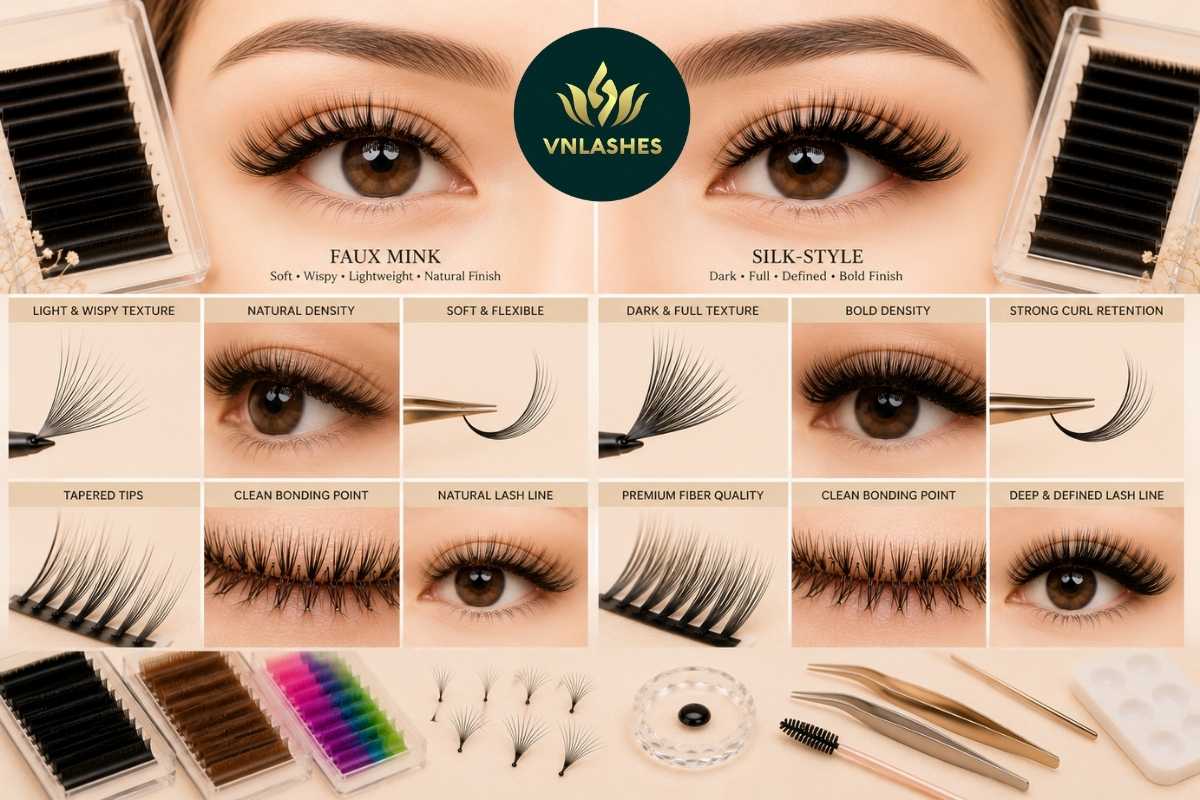
In today’s professional lash market, the term “mink lashes” usually refers to faux mink extensions made from synthetic material. These fibers are designed to imitate the fine, lightweight, and soft appearance traditionally associated with real mink fur.
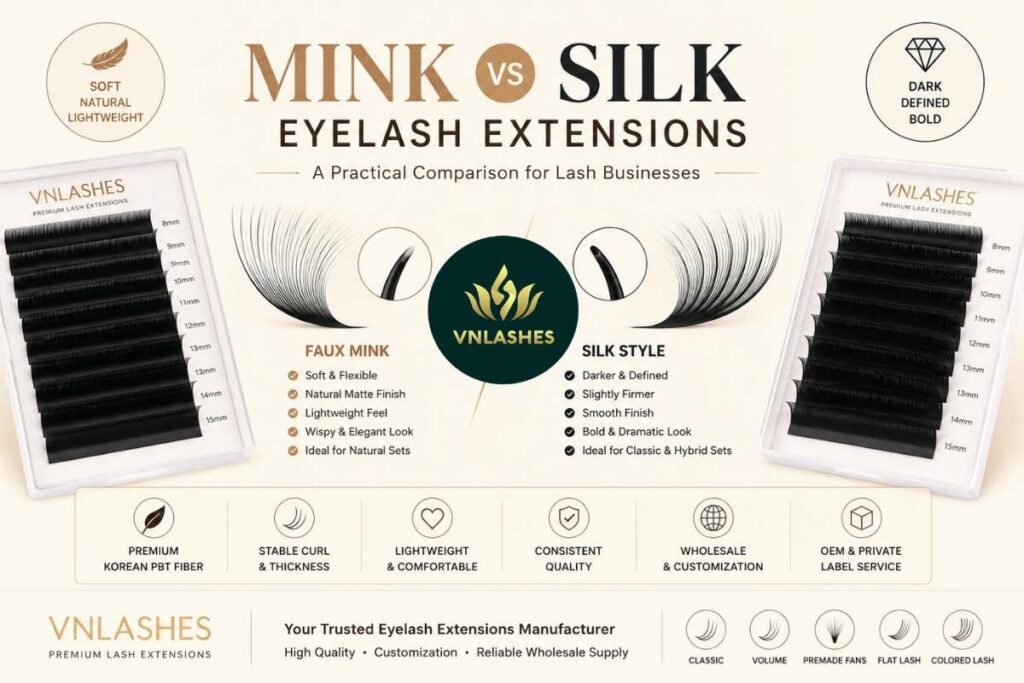
Main Features of Faux Mink Extensions
Faux mink products commonly provide:
- A soft and flexible texture
- Lightweight wear
- Fine, tapered tips
- A natural or semi-matte appearance
- Options for classic, volume, and mega-volume techniques
Their delicate structure makes them suitable for clients who prefer natural, wispy, or elegant lash sets.
What Are Silk Eyelash Extensions?
Silk eyelash extensions are also generally manufactured from synthetic PBT. The word “silk” describes the finish and structure of the fiber rather than indicating that the lashes are made from natural silk.
Compared with mink-style fibers, silk-style extensions often appear slightly darker, firmer, and more defined.
Main Features of Silk-Style Lashes
These lash fibers commonly offer:
- A rich and noticeable black finish
- Strong curl retention
- A slightly firmer structure
- Clear definition along the lash line
- Good performance in classic and volume applications
Their polished appearance makes them suitable for clients who prefer fuller, darker, or more dramatic results.
Mink vs Silk Eyelash Extensions: Key Differences
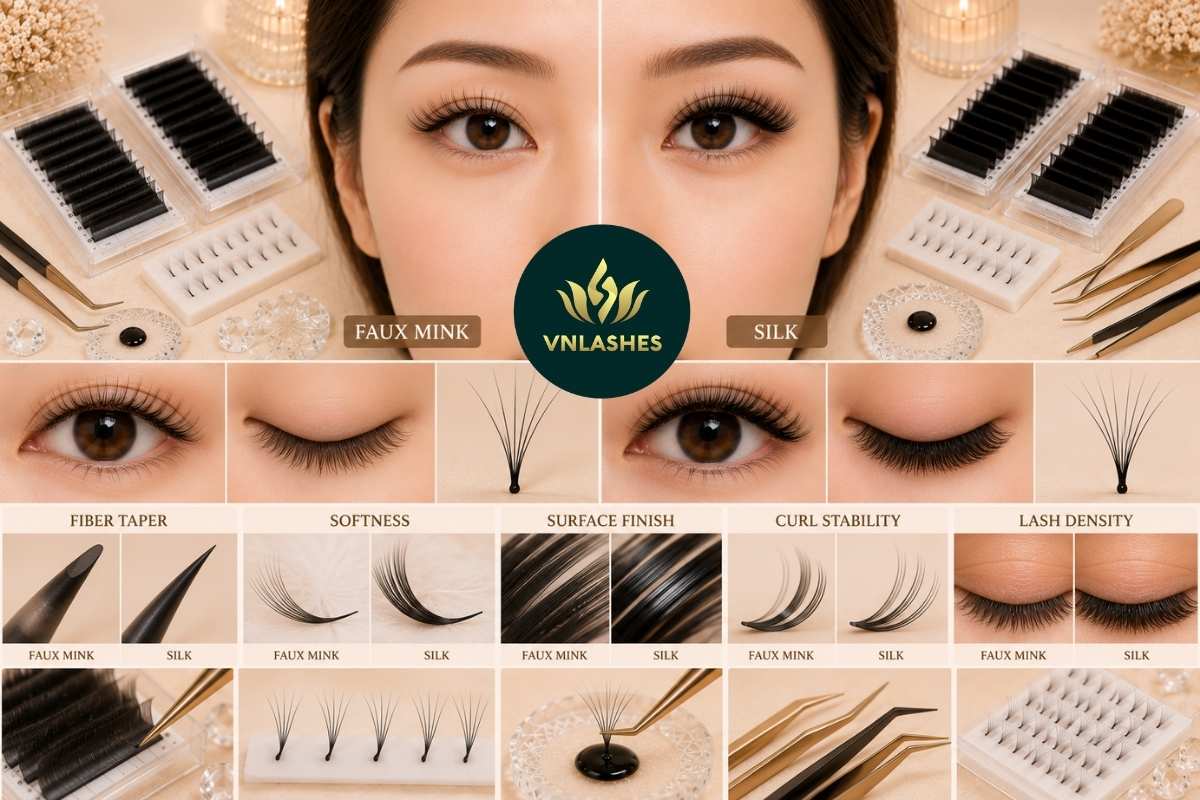
The main difference between mink vs silk eyelash extensions is usually not the raw material. Both may be made from Korean PBT, but they can vary in softness, taper, surface finish, flexibility, and visual effect.
Appearance
Mink-style fibers generally create a softer and more natural result. Their fine tapered tips blend smoothly with natural eyelashes.
Silk-style products often provide a darker and more structured appearance, helping create a stronger lash line.
Texture
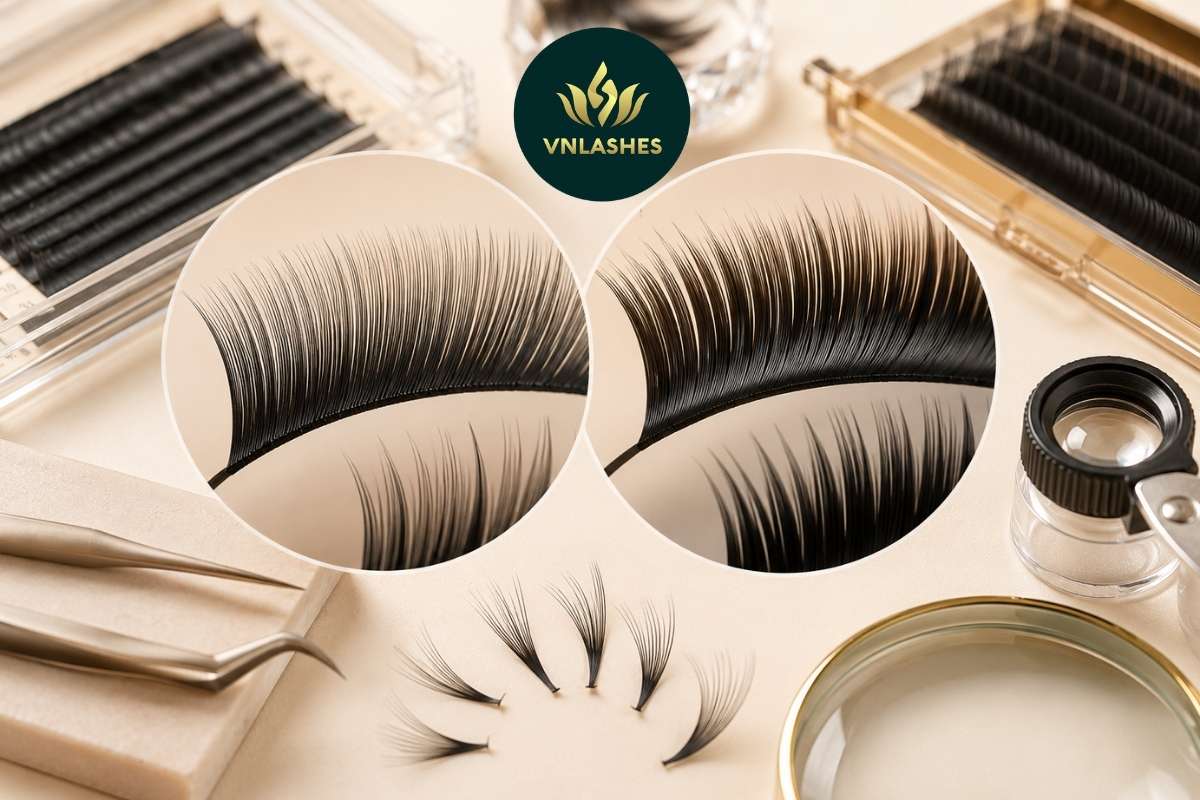
Faux mink fibers are usually softer and more flexible, making them suitable for natural, wispy, and lightweight volume designs.
Silk fibers may feel slightly firmer, which can make them easier to control during classic or hybrid applications.
Weight
Both types can be lightweight when produced in suitable diameters. Faux mink extensions are often associated with a softer, more feather-like appearance.
The actual weight depends primarily on the diameter, length, and number of fibers used in each fan.
Curl Retention
High-quality synthetic fibers can maintain their shape effectively. Korean PBT is heat-treated during production to create stable curls such as C, CC, D, L, LD, and M.
Consistent manufacturing and proper storage also help maintain curl stability.
Surface Finish
Mink-style products often have a natural, matte, or semi-matte finish.
Silk-style lashes may feature a smoother, darker, or slightly shinier surface, although the exact appearance depends on the manufacturer and product line.
Mink and Silk Lashes Comparison Table
| Feature | Faux Mink Extensions | Silk-Style Extensions |
| Common material | Synthetic PBT | Synthetic PBT |
| Appearance | Soft and natural | Darker and more defined |
| Texture | Fine and flexible | Slightly firmer |
| Finish | Matte or semi-matte | Smooth or semi-glossy |
| Suitable styles | Natural, wispy, volume | Classic, hybrid, dramatic |
| Curl retention | Strong | Strong |
| Customization | High | High |
Advantages of Faux Mink Lashes
Natural-Looking Results
The soft finish and fine taper help these extensions blend naturally with the client’s own eyelashes.
Lightweight Structure
Faux mink fibers are available in fine diameters such as 0.03, 0.05, and 0.07 mm, making them suitable for handmade fans, premade fans, and lightweight volume sets.
Wide Range of Specifications
Manufacturers can produce mink-style products in different curls, lengths, thicknesses, colors, finishes, and packaging formats.
Animal-Free Material
Synthetic fibers provide a mink-inspired appearance without using animal fur.
Advantages of Silk-Style Lashes
Stronger Lash-Line Definition
The darker finish can create a richer and more visible lash line.
Stable Fiber Shape
A slightly firmer structure may make the fibers easier to separate, pick up, and control during application.
Versatile Styling
Silk-style extensions can be used for natural, hybrid, doll-eye, cat-eye, and dramatic lash designs.
Consistent Wholesale Production
Synthetic materials allow manufacturers to maintain stable curl, color, thickness, and length across large production batches.
Which Type Should Lash Businesses Choose?
The right choice depends on the target market, customer preferences, and desired styling effect.
Choose Faux Mink Extensions When
Faux mink products are suitable for:
- Natural and soft lash sets
- Lightweight volume techniques
- Clients who prefer subtle results
- Brands focused on matte or premium-looking collections
- Salons serving customers with fine natural lashes
Choose Silk-Style Extensions When
Silk-style products may be suitable for:
- Dark and defined lash sets
- Classic and hybrid techniques
- Clients who prefer a stronger lash line
- Brands offering bold or glamorous collections
- Training academies requiring stable and easy-to-handle fibers
Many wholesalers and distributors carry both styles to serve different customer preferences.
Why Korean PBT Fiber Matters
The performance of synthetic lash extensions depends heavily on the quality of the raw fiber and the production process. Korean PBT is widely used because it offers flexibility, softness, stable curls, and consistent color.
As a lash extension manufacturer, we use premium synthetic fibers to create products with:
- Uniform curl and thickness
- Fine tapered tips
- Deep and consistent black color
- Lightweight construction
- Reliable application performance
- Stable quality across wholesale orders
The material can also be customized into matte black, glossy, brown, colored, flat, classic, volume, and premade fan collections.
Wholesale Customization Options
Wholesale buyers can customize mink-style and silk-style products according to their market and brand positioning.
Available Specifications
Common customization options include:
- C, CC, D, L, LD, and M curls
- Short, medium, and long lengths
- Diameters for classic and volume techniques
- Single-length or mixed-length trays
- Black, brown, and colored fibers
- Matte, semi-matte, or glossy finishes
- Classic, flat, volume, and premade fan styles
Private Label Packaging
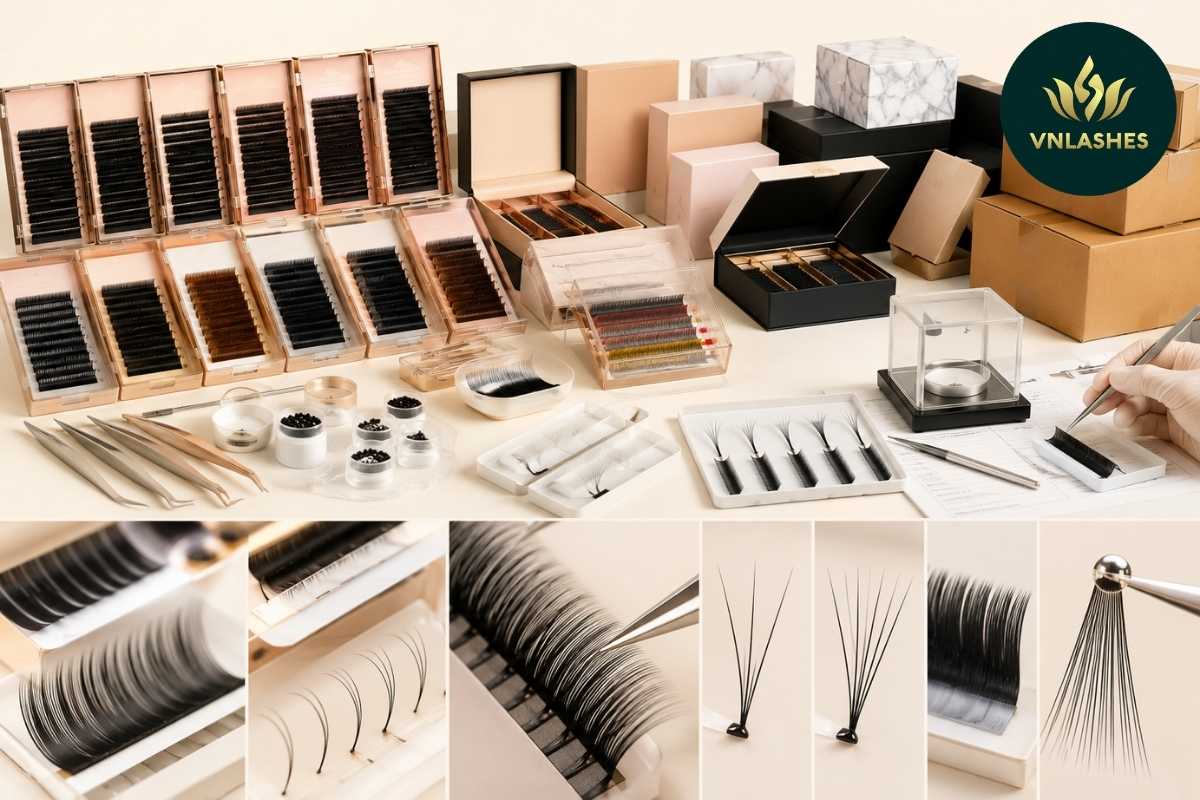
Products can be supplied with customized trays, boxes, labels, logos, and product information. This allows lash brands, distributors, and academies to build consistent private label collections.
Are Real Mink Lashes Still Used?
Real mink lashes are made from animal fur, but they are less common in the modern professional market. Their curl, thickness, hygiene, and consistency can be difficult to standardize.
Synthetic alternatives are more practical because they offer stable specifications, better quality control, consistent curls, and animal-free production.
For this reason, many professional eyelash manufacturers use PBT for both mink-style and silk-style collections.
Conclusion
When comparing mink vs silk eyelash extensions, both options can provide excellent performance when made from high-quality PBT fiber.
Mink-style extensions are generally softer, lighter, and more natural-looking, while silk-style products often appear darker, firmer, and more defined. The most suitable choice depends on the desired lash effect, target customers, and brand positioning.
For wholesalers, distributors, salons, and private label brands, offering both styles can provide greater flexibility and help serve a wider range of professional buyers.


Bài viết liên quan
Zero Time Promade Fan Lashes – Wholesale Manufacturer & OEM Services
For lash salons and professional eyelash brands, application efficiency and consistent quality are important factors...
Oct
Magic Fan And Zero Time Promade Fan – A Faster, Time-Saving Lash Extension Solution
In the professional lash extension industry, application speed and product consistency are important factors for...
Oct
Magic Fans And Zero Time Promade Fan: Are They the Same Type of Lashes?
When looking for premade lash fans, lash brands, importers, distributors, and wholesale buyers may come...
Sep
Magic Fans Lashes Manufacturer & Exporter In Vietnam – A Stable Supply Source For Wholesale Buyers
When choosing a Magic Fans Lashes Manufacturer & Exporter, wholesale buyers are usually not only...
Sep
Custom Magic Fans Manufacturing and OEM Services: Production Process
When sourcing Magic Fans in bulk, buyers need more than just an attractive lash tray....
Aug
Vietnam National Day Eyelash Promotion – Order 10 Boxes, Get 20% Off
🇻🇳 VIETNAM NATIONAL DAY EYELASH PROMOTION 🔥 VIETNAM NATIONAL DAY EYELASH PROMOTION – 10 BOXES,...
Aug